

.webp)






































Let's talk about the most powerful free marketing tool you're probably ignoring. If someone in your area pulls out their phone right now and searches for what you sell or do, one of two things happens: either your business shows up looking complete, current, and credible, or it doesn't... but your competitor's profile does.
That moment of visibility comes down to one thing more than almost anything else: your Google Business Profile.
Not your website. Not your social media. Your Google Business Profile. Your GBP is the listing that appears in Google Search and Google Maps when someone actively searches for a business like yours near them.
Key Takeaways
- Your Google Business Profile is more than a directory listing. In the current digital environment, it functions as your digital front door, and over 70% of local searches result in direct GBP interaction.
- Google loves content that lives inside its own ecosystem. A complete, active GBP signals legitimacy and earns recommendation priority in local search results.
- NAP consistency -- your Name, Address, and Phone number -- must be identical across your GBP, your website, and every online directory. Mismatches hurt your ranking.
- Your primary category is one of the highest-impact fields on your entire profile. Get it wrong, and no amount of effort elsewhere fully compensates.
- The Services section feeds directly into Google's AI-generated answers about your business. If a service isn't listed, Google doesn't know to recommend you for it.
- Reviews are a direct local ranking factor. Ask for them consistently, respond to every single one, and treat your review strategy as a non-negotiable part of doing business.
- Google Posts are a freshness signal. Consistent posting tells Google your business is active and worth recommending. Inconsistency does the opposite.
- Profiles with quality photos receive up to 42% more direction requests and calls. Update your photos regularly and add short video content when possible.
- Google discontinued the Q&A section in late 2025. It has been replaced by Ask Maps, an AI-powered feature that generates answers about your business using your GBP data, reviews, and website. The only way to influence those answers is to keep your profile complete and accurate.
- Having a Google Business Profile and actively optimizing one are two very different things. Businesses winning in local search treat their GBP like the marketing asset it is.
Over 70% of local searches now result in direct interaction with a Google Business Profile. That means people call, click, or get directions straight from that listing, often without ever visiting a website. Your GBP is not a footnote to your digital presence. In 2026, it is your digital front door.
And Google gives it to you for free.
The question isn't whether you have one. The question is whether it's actually working for you.
Why Your Google Business Profile Matters Even More in the Age of AI Search
Here's something most business owners don't know yet: as Google's AI features take over more and more of what used to be traditional search results, your Google Business Profile has become one of the primary sources Google pulls from to answer questions about your business.
When someone searches for a plumber, a dentist, a hair salon, or a contractor near them, Google increasingly answers that question directly on the results page -- sometimes before a single website link appears. The data powering those answers comes from your GBP: your categories, your service descriptions, your photos, your reviews.
Think of it this way: Google's algorithm has always preferred content that lives inside Google's own ecosystem. Your GBP is exactly that. A well-maintained, fully built-out profile tells Google that your business is legitimate, active, and worth recommending. Ignore it, and you are handing that advantage to whoever in your market took the time to fill theirs out.
The businesses winning in local search right now are not necessarily the biggest or best-known. They are the ones that treat their GBP like a living, breathing marketing asset, almost like a mini-website.
Let's talk about how to do that.
Start With the Foundation: Get the Basics Exactly Right
Before you think about strategy, you have to get the foundation right. And the foundation is simpler than it sounds. It's your NAP: Name, Address, and Phone number.
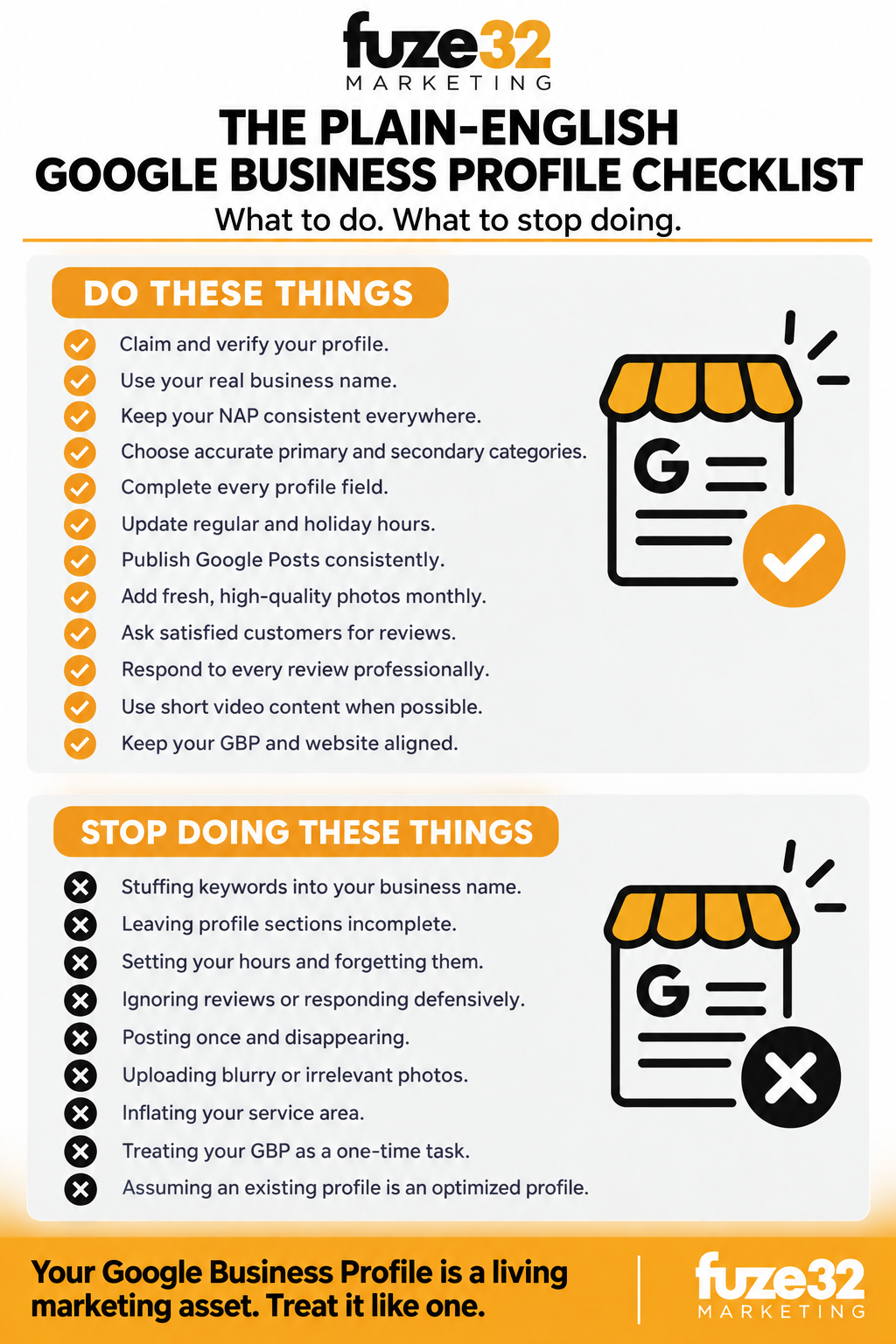
Your business name on your GBP must match exactly what appears on your storefront, your website, and your legal documents. That means no keyword stuffing. No adding phrases like 'Best Plumber in Jefferson City' after your business name to try to rank higher for those terms. Google catches this and will suspend your profile for it. Just your real business name, spelled exactly as it appears everywhere else.
Your address and phone number need to match what's on your website and every other online directory you're listed in. That list includes Yelp, Facebook, the Better Business Bureau, your chamber of commerce listing, all of it. When Google consistently sees the same name, address, and phone number across the internet, it gains confidence that your business is legitimate. When those details don't match, that confidence erodes, and so does your ranking.
Your hours matter more than most people realize. Inaccurate hours are one of the top reasons customers leave negative reviews. Someone drives across town because Google said you were open, and you're not. That's not just a lost customer; it's an angry one. Update your regular hours any time they change, and set special hours for holidays and seasonal shifts before they happen, not after.
One more thing on completeness: profiles that are fully filled out receive 70% more visits and appear 18 times more often in search results than incomplete ones. Every blank field is a missed opportunity. Fill everything out.

Categories: The Most Underestimated Field on Your Entire Profile
Here is something that will surprise most business owners: your primary category on your Google Business Profile carries more ranking weight than almost anything else on the page. It is the single field that tells Google what kind of business you are and determines whether you show up when someone searches for that type of business nearby.
Get it wrong, and no amount of reviews, posts, or photos will fully make up for it.
Google provides a predefined list of categories, and you have to choose from that list. The key is to pick the most specific and most accurate option available. A general contractor who specializes in kitchen remodels should look for 'Kitchen Remodeler' rather than settling for 'General Contractor' if both options exist. Specificity wins.
Beyond your primary category, you can add secondary categories to capture additional searches. A bakery that serves coffee should add 'Coffee Shop' as a secondary category. An HVAC company that also handles plumbing should reflect both. Secondary categories expand the range of searches your profile is eligible to appear in, so use them thoughtfully and accurately.
Google periodically expands its category list, so check in at least once a year to see whether a more specific option has been added for your type of business.
Treat It Like a Mini-Website: Services, Description, and Attributes
Here is where most business owners stop, and where the real opportunity begins.
Your business description gives you 750 characters to tell Google and potential customers exactly who you are, what you do, and who you serve. Use them! Lead with what matters most. Write like a human being, not a keyword list. Mention your location, your primary services, and what makes you worth calling. This is your elevator pitch for someone who has never heard of you.
Your Services section is one of the most neglected and most powerful parts of your profile. List every core service you offer with a clear, specific description for each one. This content feeds directly into Google's AI-generated responses when someone searches for what you do. If a service isn't listed, Google doesn't know to recommend you for it. It really is that straightforward.
Attributes are the checkboxes and detail fields that most people skip entirely. They include things like whether you offer free consultations, whether your location is accessible, whether you offer financing, whether you're veteran-owned or woman-owned. Google's algorithm gives weight to these details because they help match your business to searchers who are specifically looking for those qualities. Check every box that honestly applies.
Reviews: Your Single Biggest Trust Signal
Most consumers today trust online reviews as much as a personal recommendation from a friend. Read that again. A stranger's review on Google carries the same weight as a referral from someone they know personally. That's the world your business is operating in, and your review strategy needs to reflect it.
The first thing to understand about reviews is that you have to ask for them. Satisfied customers rarely leave reviews on their own, not because they don't want to, but because nobody asked. Make requesting a review a standard part of your customer experience. Send a follow-up text or email after every completed job. Hand someone a card with a QR code at checkout. Mention it at the end of a service call. Build it into your process so it happens consistently, not just when you remember.
The second thing to understand is that you must respond to every review…every single one. That includes both the five-star reviews AND the two-star ones. A thoughtful, professional response to a negative review does more for your reputation than you might think. Prospective customers read how you handle criticism as much as they read the criticism itself. Keep your responses human. Avoid canned language. Where it makes sense, mention a specific service or your location in your reply, because that extra context helps Google connect your responses to relevant searches.
Reviews are also a direct ranking factor. Google uses the quality, quantity, and recency of your reviews to help determine your placement in local results. In competitive markets, a stronger review profile is often the deciding factor between showing up in the top three results and not showing up at all.
Google Updates: The Freshness Signal Nobody Is Using
Google Updates are short mini-blog posts you can publish directly to your GBP. Think of them like social media posts, except they appear on your Google listing instead of a social feed. Most businesses either don't know they exist or post once and never again.
Here's what they actually do: they signal to Google that your business is active, paying attention, and still open. Google wants to recommend businesses it's confident are currently operating. Consistent posting activity is one of the clearest signals you can send that your business is alive and engaged. When Google sees regular updates, it gains confidence in your listing. When a profile goes silent for months, that confidence fades.
Posts don't need to be elaborate. A seasonal promotion, a new service announcement, a team highlight, a community event you're involved in, a reminder of your holiday hours -- all of it counts. The goal is consistency over brilliance. Once a week is better than once a month. Once a month is infinitely better than never.
If you're already creating content for social media, repurposing it as a GBP post takes about two minutes and puts that content in front of people who are actively searching for your business category right now. That's a better-qualified audience than most social feeds deliver.
Photos and Video: Show Up Before They Show Up
Google's own data shows that business profiles with quality photos receive up to 42% more requests for directions and more phone calls than profiles without them. That number alone should be reason enough to take this seriously.
Photos do something words can't: they let a potential customer form an impression of your business before they ever interact with you. A well-lit photo of your team, your facility, or your completed work builds a level of trust that no description can fully replicate. It says: we are real, we are professional, and here is the proof.
What to post: your team at work, your physical location inside and out, completed projects or finished products, branded vehicles or signage, and anything that gives a prospective customer a clear sense of who you are and what working with you looks like. Keep the quality high. Blurry, dark, or irrelevant photos do more harm than good.
Short videos are increasingly weighted in GBP engagement. Even a simple thirty-second walk-through of your space or a quick before-and-after of a completed project outperforms static images for interaction. You don't need a production crew. You need a steady hand and decent lighting.
Update your photos regularly. A profile with the same five photos from three years ago signals the same thing as a profile that never posts updates: inactivity. Fresh visuals communicate that your business is current, thriving, and worth a second look.
What Replaced Q&A and Why Your Profile Data Just Got More Important
If you remember the Questions and Answers section that used to appear on Google Business Profiles, it's gone. Google officially discontinued it in late 2025, and new profiles are created without it entirely.
What replaced it is more interesting and, frankly, higher stakes. Google rolled out a feature called Ask Maps, powered by its Gemini AI. Instead of a static list of user-submitted questions and answers, customers can now ask a natural language question directly, i.e., 'Do they offer same-day service?' or 'Is this place good for large groups?', and Google's AI generates an answer on the spot.
Here is the part that matters for your business: those AI-generated answers are pulled from your GBP information, your reviews, your photos, and your website. Google's AI is now speaking on your behalf to potential customers, whether your profile is ready for that or not.
If your profile is incomplete, your services are vague, or your information is outdated, the AI is going to give a vague or potentially inaccurate answer about your business. You no longer have a manual Q&A section to control that narrative. The only way to influence what the AI says about you is to make sure every other part of your profile is optimized, accurate, and thorough.
This is not a reason to panic. It is a reason to get your GBP in order. The businesses that have been treating their profiles as a living, well-maintained asset are going to have their AI-generated answers reflect that. The ones that haven't are about to find out.
The Bottom Line: Google Rewards What Lives in Google's World
Here is the simplest way to think about all of this: Google wants to recommend businesses it can trust. And the way it decides who to trust is by looking at the quality, accuracy, consistency, and activity level of the information available about your business, especially the information that lives directly inside Google's own ecosystem.
Your Google Business Profile is that ecosystem. It is the most direct line between your business and Google's confidence in your business. When that profile is complete, current, active, and backed by genuine reviews, Google has every reason to put you in front of people who are ready to buy.
And remember: if someone decides they want to do business with you, they are coming to your website or your GBP to seal the deal. Your job is to make sure that when they arrive, what they find makes the decision easy.
This is not complicated. It is not expensive. It just takes attention -- the kind of attention that most of your competitors are not paying.
That's your opportunity. Take it.
Want One More Tip Your Competitors Are Probably Ignoring?...
There’s one more place you need to have a listing that most people overlook: Bing Places. Bing makes setup surprisingly simple, allowing you to import and sync information from your Google Business Profile rather than rebuilding everything from scratch. It takes little effort, expands your visibility beyond Google, and strengthens your business’s digital footprint in places your competitors may be ignoring.

Frequently Asked Questions
Is a Google Business Profile really free?
Yes, completely. There is no monthly fee, no subscription, and no catch. Google provides GBP because local search is one of its most valuable services, and businesses with complete, accurate profiles deliver a better experience to searchers. You are doing Google a favor by keeping yours optimized and Google returns that favor with visibility.
How is a Google Business Profile different from my website?
Your website builds depth, authority, and the full story of your business. Your GBP is where Google sends people when they are actively looking for what you offer right now, nearby. They serve different purposes and work best together. Your website earns long-term trust. Your GBP drives immediate local action. In 2026, for many local businesses, the GBP is actually generating more direct contacts -- calls, directions, clicks -- than the website itself.
What is NAP consistency and why does it matter?
NAP stands for Name, Address, and Phone number. Google cross-references your GBP data against other places your business appears online -- your website, Yelp, Facebook, directories, and more. When that information matches everywhere, Google gains confidence that your business is real and legitimate. When it doesn't match, that confidence drops, and your local ranking suffers. Even small discrepancies like an abbreviated street name on one platform versus a spelled-out one on another can cause problems.
How often should I post to my Google Business Profile?
Once a week is a solid target. The goal is consistency, not volume. Google Posts function as a freshness signal. They tell Google that your business is active and engaged. A business that posts regularly is treated as more reliable than one that went silent six months ago. If weekly feels like too much, start with twice a month. Just don't go dark.
Do I really need to respond to negative reviews?
Absolutely yes -- and arguably those matter more than your responses to positive ones. When a prospective customer reads a negative review, what they're really evaluating is how you handled it. A calm, professional, solution-oriented response communicates maturity and accountability. Ignoring a negative review or responding defensively communicates the opposite. Respond to every review. Keep it human. Keep it professional. It is one of the most visible expressions of your customer service that exists.
What happened to the Q&A section on Google Business Profiles?
Google officially discontinued the Q&A feature in late 2025. It has been replaced by Ask Maps, an AI-powered tool built on Google's Gemini technology. Instead of static user-submitted questions and answers, customers can now ask natural language questions and receive AI-generated responses pulled from your GBP data, your reviews, your photos, and your website. The practical implication is that keeping your profile complete and accurate is now more important than ever -- it is the only way to influence what the AI says about your business.
How many photos should my profile have?
More than you think, and fresher than you probably have. At minimum, make sure you have a strong cover photo, a logo, interior and exterior shots of your location if applicable, team photos, and examples of your work or products. Add new photos regularly, i.e., monthly at minimum. Profiles with a robust, current photo gallery receive significantly more direction requests and calls than those with a handful of outdated images. And if you can add short video, do it. Even thirty seconds of footage outperforms static photos for engagement.
My profile is already set up. Do I really need to keep working on it?
Yes. And this is the most important answer on this list. A Google Business Profile is not a one-time setup task. It is a living marketing asset that requires ongoing attention. Hours change. Services evolve. Reviews accumulate and need responses. Posts need to keep coming. Photos need to stay current. Google's features update. The businesses that understand this are the ones that consistently outrank and out-convert the ones that set their profile up once and walked away.
Want a Free Google Business Profile Audit?
The team at fuze32 Marketing works with businesses nationwide to optimize their digital presence for how search actually works in 2026. If you'd like to know where your GBP stands and what it's costing you to leave it as-is, let's talk.